
ETEA (Educational Testing and Evaluation Agency) was established by the Government of KPK to conduct transparent, merit-based entry tests for engineering, medical, and other professional institutions across Khyber Pakhtunkhwa — replacing external testing agencies. For FSC Pre-Engineering students in KPK, the ETEA Engineering test is the gateway to a BE degree at UET Peshawar and all other affiliated engineering universities.
This guide is based on official information from ETEA and covers everything: the correct test pattern (100 MCQs delivered via Computer-Based Test (CBT) — Physics 40, Maths 35, English 15, Chemistry/CS 10), the complete subject-wise syllabus, step-by-step registration, affiliated universities, merit calculation, best books, and a structured month-by-month prep plan.
- What is ETEA Engineering?
- Registration Process (Step by Step)
- Paper Pattern at a Glance
- Subject-Wise Syllabus
- Universities Affiliated with ETEA
- Merit Formula & Aggregate Calculation
- Best Books & Resources
- Month-by-Month Preparation Plan
- Exam-Day MCQ Strategy
- 5 Mistakes That Cost Students Marks
- Frequently Asked Questions
1. What is ETEA Engineering?
ETEA (Educational Testing and Evaluation Agency) was established by the Government of Khyber Pakhtunkhwa to administer entrance tests for admission to engineering and medical institutions in KPK, replacing external testing agencies. It conducts transparent, merit-based entry tests for engineering, medical, and other professional programs, as well as screening tests for public sector recruitment.
The ETEA Engineering test is specifically for students seeking admission to engineering universities in KPK — primarily for BE degrees at institutions like UET Peshawar. ETEA conducts the test and publishes scores; merit lists are then compiled at the institute level — each affiliated university sets its own eligibility criteria and merit formula independently.
The test is typically conducted twice per year — Phase-I and Phase-II — usually announced in June–July and held July–August before the academic year begins. Test centres are located across KPK including Peshawar, Abbottabad, Mardan, Swat, D.I. Khan, Kohat, and Bannu.
FSC Pre-Engineering students are the primary applicants — Mathematics, Physics, and Chemistry are their main subjects, and the ETEA paper is built directly around those three.
FSC Pre-Medical students can also appear for ETEA Engineering. However, because Biology replaces Mathematics in the Pre-Medical group, students without Additional Mathematics in their FSC will find both the Physics (40 MCQs) and Maths (35 MCQs) sections harder to prepare for. Pre-Medical applicants at most institutes face a higher closing merit, meaning a better aggregate is needed to secure the same program. Taking Additional Mathematics as an FSC elective is strongly recommended for any Pre-Medical student considering an engineering career.
DAE (Diploma of Associate Engineering) holders (3-year post-Matric diploma) are also eligible for lateral entry into the 2nd year of BE programs via a separate DAE merit list.
2. Registration Process (Step by Step)
ETEA registration is entirely online. The process is straightforward — follow these six steps:
-
Visit the ETEA official website
Go to etea.edu.pk/applicants and open the Engineering registration portal. -
Fill the online registration form
Enter your personal details, FSC board, and subject group. Double-check every field before submitting. -
Pay the registration fee (via bank)
A bank challan is generated after form submission. Deposit the fee at any designated bank branch and upload the payment proof online. -
Download your Roll Number Slip
After fee verification, your roll number slip becomes available on the portal. Print it and carry it to the test centre. -
Appear in the test
Bring your roll number slip and original CNIC/B-Form on test day. Test centres are assigned based on the city you select during registration. -
Check your result online
Results are announced on the ETEA website. You then apply directly to your preferred affiliated university using your ETEA score.
All registration, roll number slips, results, and affiliated university lists are available at the official ETEA portal: etea.edu.pk
3. Paper Pattern at a Glance
| Feature | Detail |
|---|---|
| Total MCQs | 100 |
| Format | Computer-Based Test (CBT), MCQ Updated 2026 |
| Negative Marking | None — attempt every question |
| Physics | 40 MCQs — 40% (highest weight) |
| Mathematics | 35 MCQs — 35% |
| English | 15 MCQs — 15% |
| Chemistry / CS | 10 MCQs — 10% |
| Test Frequency | Twice per year — Phase-I & Phase-II |
ETEA Engineering has zero negative marking. A wrong answer costs nothing. Fill in an answer for every single MCQ — even on questions you are unsure about. A random guess gives you a 25% chance of a free mark. A blank gives you zero.
4. Subject-Wise Syllabus
The ETEA Engineering syllabus covers FSC Pre-Engineering Parts 1 and 2, based on the KPK Textbook Board (KPKTBB) curriculum. Federal Board books cover the same topics with minor differences in chapter ordering.
Physics — 40 MCQs (40%) Highest Weight
Physics carries the most marks in ETEA Engineering — 40 MCQs out of 100. It tests both conceptual understanding and numerical problem-solving. Formula recall is essential — many MCQs give you numbers and ask for a calculated quantity directly.
| Part | Chapters & Key Topics |
|---|---|
| FSC I | Measurements (SI units, errors, significant figures, dimensions) · Scalars & Vectors (addition, resolution, unit vectors) · Motion & Force (velocity, acceleration, Newton's laws, friction) · Work, Energy & Power (conservation, KE, PE, power) · Circular Motion (angular velocity, centripetal force, artificial gravity) · Fluid Dynamics (pressure, Bernoulli's equation, Stokes' law, viscosity) · Oscillations (SHM, spring-mass, pendulum, resonance) · Waves (transverse/longitudinal, speed, superposition, standing waves, Doppler effect) |
| FSC II | Thermodynamics (temperature scales, specific heat, first & second law, entropy) · Electrostatics (Coulomb's law, electric field, Gauss's law, capacitance, dielectrics) · Current Electricity (Ohm's law, resistivity, Kirchhoff's laws, Wheatstone bridge) · Electromagnetism (Biot-Savart, Ampere's law, magnetic force, Hall effect) · Electromagnetic Induction (Faraday's law, Lenz's law, mutual inductance, transformers) · Alternating Current (RLC circuits, resonance, power factor) · Physics of Solids (band theory, semiconductors, p-n junction) · Electronics (diodes, transistors, logic gates, op-amps basics) · Dawn of Modern Physics (photoelectric effect, Compton effect, de Broglie) · Atomic Spectra (Bohr model, energy levels, hydrogen spectrum) · Nuclear Physics (radioactive decay, half-life, fission, fusion, radiation safety) |
Based on past ETEA Engineering papers: Electrostatics, Current Electricity, Electromagnetism, Newton's Laws & Motion, and Oscillations/Waves appear most frequently. Prioritise numerical MCQs — know your formulas cold for every FSC II chapter.
Mathematics — 35 MCQs (35%)
Mathematics is the second-largest section and the one where marks are most easily dropped if concepts are weak. Every chapter from both FSC I and II is in scope — there are no optional topics.
| Part | Chapters & Key Topics |
|---|---|
| FSC I | Number Systems (real, complex, rational) · Sets, Functions & Groups · Matrices & Determinants (operations, inverse, Cramer's rule) · Quadratic Equations (roots, nature of roots, relations) · Partial Fractions · Sequences & Series (AP, GP, HP) · Permutations, Combinations & Probability · Mathematical Induction & Binomial Theorem · Fundamentals of Trigonometry (units, identities, values) · Trigonometric Identities (product-to-sum, double/half angle) · Trigonometric Functions & Graphs · Inverse Trigonometric Functions · Solutions of Triangles (sine rule, cosine rule, area) |
| FSC II | Functions & Limits (types, L'Hôpital's rule, continuity) · Differentiation (rules, higher derivatives, implicit) · Applications of Differentiation (maxima/minima, rate of change, tangent/normal) · Integration (standard integrals, substitution, by parts) · Definite Integrals & Area under Curve · Introduction to Analytic Geometry (distance, section formula, slope) · Linear Inequalities & Linear Programming · Conic Sections (circle, parabola, ellipse, hyperbola — equations & properties) · Vectors (dot product, cross product, triple products, 3D vectors) |
Based on past ETEA Engineering papers: Quadratic Equations, Trigonometric Identities, Differentiation, Integration, Conic Sections, and Matrices appear most frequently. Prioritise these in your revision — expect 3–5 MCQs from each of the heavy topics.
Chemistry / CS — 10 MCQs (10%)
Chemistry carries only 10 MCQs — the smallest section in ETEA Engineering. Despite covering the full FSC Pre-Engineering Chemistry syllabus, you should target quick revision over deep coverage here. Organic Chemistry reactions (Part 2) typically appear most in this section.
| Part | Chapters & Key Topics |
|---|---|
| FSC I | Basic Concepts (stoichiometry, mole, Avogadro's number, limiting reagent) · Atomic Structure (quantum numbers, orbitals, electronic configuration) · Gases (gas laws, kinetic molecular theory, ideal gas equation, real gases) · Liquids & Solids (intermolecular forces, hydrogen bonding, crystal lattice) · Chemical Bonding (ionic, covalent, metallic, VSEPR, hybridisation, polarity) · Thermochemistry (enthalpy, Hess's law, bond energies, Gibbs free energy) · Electrochemistry (oxidation states, electrolysis, electrode potential, SHE) · Chemical Equilibrium (Kc, Kp, Le Chatelier's principle, solubility product) · Reaction Kinetics (rate law, order, activation energy, catalysis) |
| FSC II | s & p Block Elements (Group I–VII periodic trends, reactions) · Transition Elements (d-block, general properties, colour, complexes) · Fundamental Organic Chemistry (classification, isomerism, functional groups) · Hydrocarbons (alkanes, alkenes, alkynes, benzene — reactions & mechanisms) · Alkyl Halides (SN1, SN2, E1, E2 reactions) · Alcohols & Phenols (reactions, acidity, esterification) · Aldehydes & Ketones (nucleophilic addition, oxidation/reduction) · Carboxylic Acids & Derivatives (amides, esters, acid chlorides) · Macromolecules (amino acids, proteins, polymers — addition & condensation) |
English — 15 MCQs (15%)
English carries more weight than Chemistry in ETEA Engineering (15% vs 10%). It is the easiest section to secure near-perfect marks in with minimal targeted preparation. 2–3 focused practice sessions are enough to cover the entire scope.
| Area | What Appears |
|---|---|
| Vocabulary | Synonyms, antonyms, one-word substitutions, contextual meaning |
| Grammar | Tenses, subject-verb agreement, articles, prepositions, active/passive voice |
| Sentence Structure | Identify correct or incorrect sentences; spot errors in word order and usage |
| Comprehension | Short passage with 3–4 direct questions; text-explicit answers only |
5. Universities Affiliated with ETEA
ETEA publishes the full list of affiliated institutions at etea.edu.pk. Students apply directly to their chosen universities after ETEA results are announced — merit lists are compiled by each institute, not by ETEA.
Core Engineering Universities — ETEA Mandatory
These universities require ETEA for engineering admissions. Most use the portal at enggentrancetest.pk.
| Institution | City |
|---|---|
| University of Engineering & Technology (UET) Peshawar | Peshawar |
| UET Mardan | Mardan |
| UET Abbottabad Campus | Abbottabad |
| UET Bannu Campus | Bannu |
| UET Kohat Campus | Kohat |
| CECOS University of IT & Emerging Sciences | Peshawar |
| Bannu University of Science and Technology | Bannu |
Private Engineering Universities — ETEA Accepted (KPK)
| Institution | City |
|---|---|
| Sarhad University of Science & Information Technology | Peshawar |
| Abasyn University | Peshawar |
| City University of Science & Information Technology | Peshawar |
| Iqra National University | Peshawar |
Universities Using ETEA for BS Programs (Non-Engineering)
| Institution | City |
|---|---|
| University of Peshawar | Peshawar |
| University of Malakand | Chakdara |
| University of Swat | Swat |
| Kohat University of Science and Technology (KUST) | Kohat |
Note: The affiliated institutions list is updated by ETEA each year. Always verify at etea.edu.pk before applying.
6. Merit Formula & Aggregate Calculation
ETEA only conducts the test and publishes scores. Merit lists are compiled at the institute level — each affiliated university sets its own eligibility criteria, weightings, and formula independently. Always read the specific prospectus of the university you are applying to.
A commonly used formula by many KPK engineering universities is:
Formula varies by institute — verify in the official prospectus
How to calculate each component (using this common formula):
- ETEA: (Your score ÷ 100) × 50
- FSC: (Your FSC % ÷ 100) × 40
- Matric: (Your Matric % ÷ 100) × 10
Example: ETEA 78/100, FSC 85%, Matric 88%:
- ETEA: (78/100) × 50 = 39.0
- FSC: (85/100) × 40 = 34.0
- Matric: (88/100) × 10 = 8.8
- Aggregate = 81.8 / 100
Under the common 50/40/10 formula, ETEA contributes half your aggregate. Every 5 marks you gain in ETEA (e.g., from 70 to 75 out of 100) adds 2.5 points to your aggregate. To gain the same 2.5 points through FSC alone you would need to increase your FSC percentage by 6.25%. ETEA preparation should be your primary focus.
If you come from FSC Pre-Medical (Biology group), you can sit for ETEA Engineering — but you should be aware of two important realities:
- Your closing merit will be higher. Pre-engineering students have studied Physics and Maths as core subjects for 2 years — they naturally score higher on 75% of the ETEA paper (Physics 40 + Maths 35). This pushes the pre-medical closing merit up at most institutes — you need a stronger overall aggregate to compete for the same seats.
- Additional Mathematics (elective) changes everything. If you took Additional Mathematics as an elective subject in FSC Pre-Medical, your merit is calculated closer to the pre-engineering group. Additional Math marks strengthen your FSC component and demonstrate mathematical preparation. If you are currently in FSC Pre-Medical and considering engineering, add Mathematics as an elective now — it can be the difference between securing a seat and falling short.
Pre-Medical students without Additional Math who still wish to attempt ETEA Engineering should allocate significant extra preparation time to the Physics and Maths syllabus (FSC I + II for both subjects). Consider tutoring or a crash course alongside regular Biology preparation.
Approximate Score Benchmarks for UET Peshawar (Past Years)
| Program | Typical ETEA Score Needed (/100) | FSC % to Pair With |
|---|---|---|
| CS / Software Engineering (most competitive) | 85+ | 88%+ |
| Electrical Engineering | 80–85 | 85%+ |
| Mechanical Engineering | 75–82 | 83%+ |
| Civil Engineering | 70–78 | 80%+ |
Indicative only — actual cutoffs shift each year based on seat count and applicant scores. Always check the official university merit lists from the previous year as your real benchmark.
Actual UET Peshawar Merit Lists — Reference Data
Below are real merit list snapshots from UET Peshawar. Use these as your concrete benchmark — not estimates.
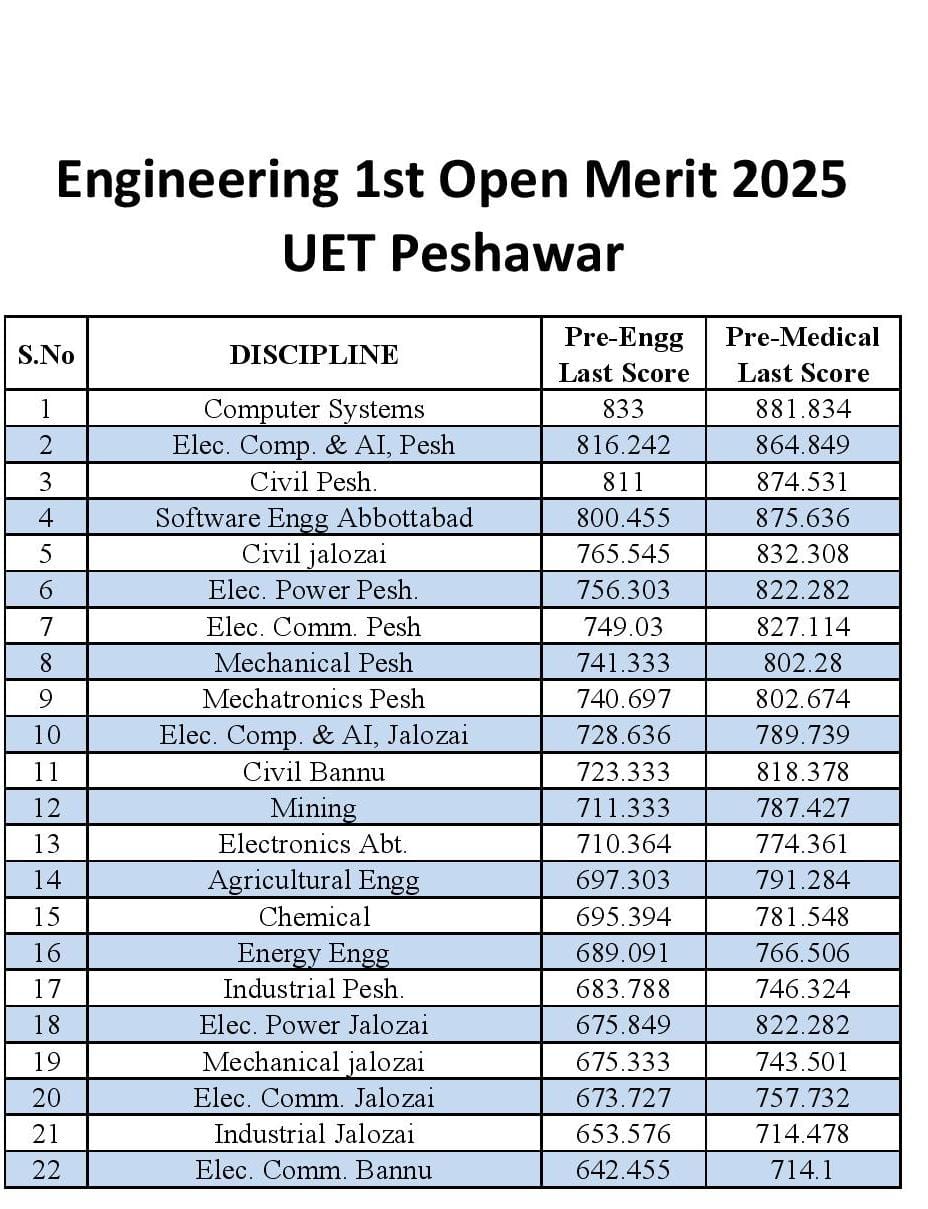
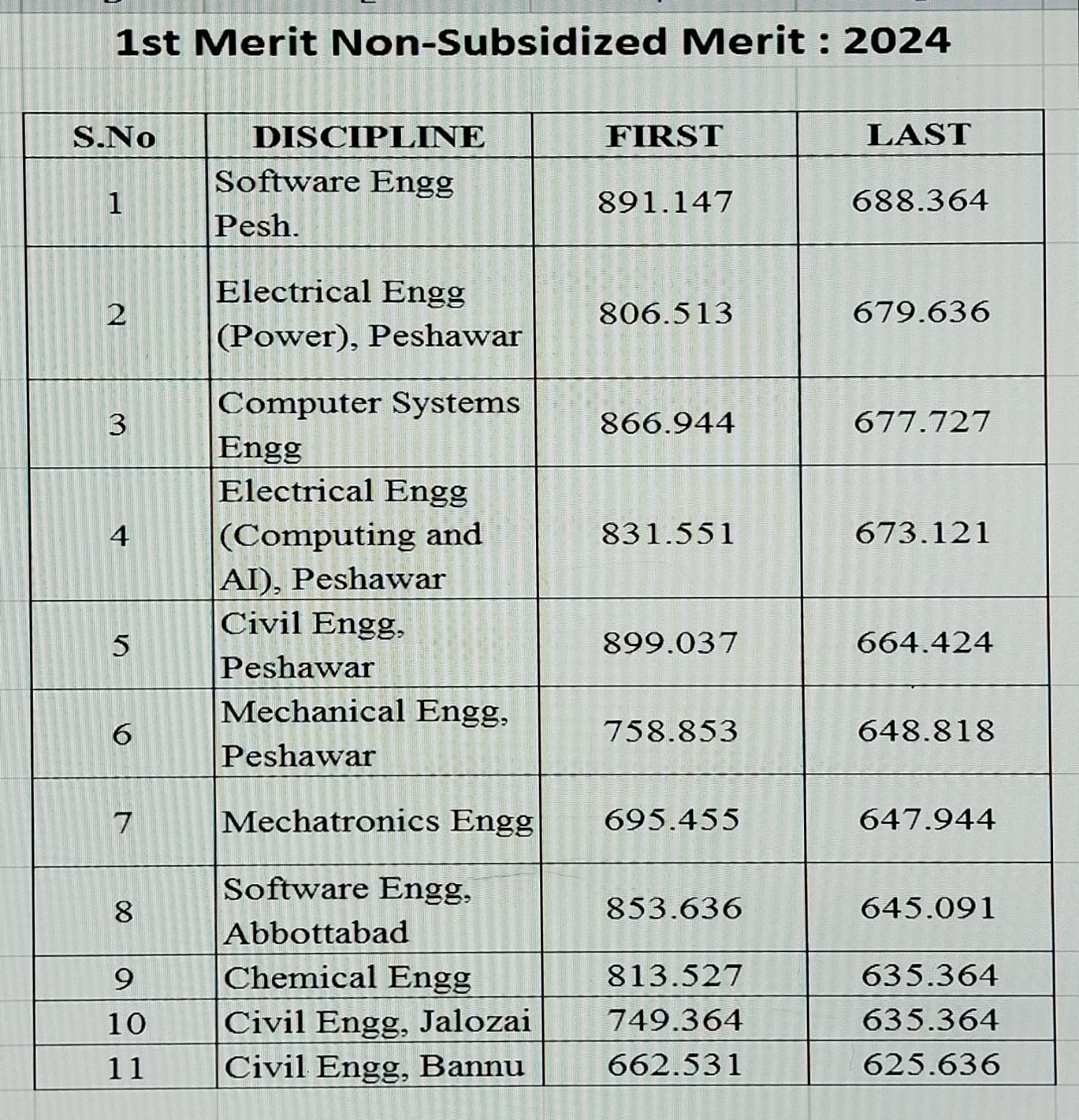
- Aggregate scale: UET Peshawar merit scores are out of 1000 — not out of 100. The university combines Matric + FSC + ETEA and scales to 1000. Compare your expected aggregate against the "Last Score" column for your target discipline.
- Pre-Medical vs Pre-Engineering gap: In every single discipline, the Pre-Medical closing merit is higher than Pre-Engineering. The gap ranges roughly 30–80 points depending on the program. This directly confirms why Pre-Medical students without Additional Mathematics face a harder path.
- Self-Finance seats: Non-subsidized seats close at lower merits than open merit. If your aggregate is just under the open merit cutoff, apply for self-finance — it is a genuine second chance at the same program and university.
7. Best Books & Resources for ETEA Engineering 2026
Primary Textbooks (Non-Negotiable)
- KPK Textbook Board FSC Maths, Physics, Chemistry Parts 1 & 2 — The ETEA syllabus is written directly from these. Study from these books first, not from guide books.
- Federal Board FSC books — Excellent alternative for non-KPK students; covers the same content with very minor differences.
MCQ Practice Books
- Dogar Brothers ETEA Engineering Guide — Widely available, has topic-wise MCQs and previous year papers aligned to the ETEA pattern.
- Kips ETEA Engineering Practice Book — Good for timed mock tests and identifying weak chapters.
- ETEA Official Past Papers (5–7 years) — The most important practice resource. ETEA questions repeat in style, difficulty, and concept every year. Solving past papers is the single best investment of your final preparation weeks.
Subject-Specific Tips
- Maths: Pure practice — solve 40–50 MCQs per chapter. You cannot read your way to Maths marks; you have to solve problems repeatedly until you recognise question types instantly.
- Physics: Make a formula sheet. Every chapter has 5–10 key formulas. If you know these cold, numerical MCQs become easy marks.
- Chemistry: Focus on Organic Chemistry reactions — they appear disproportionately in ETEA Engineering. Know all the name reactions and their mechanisms.
8. Month-by-Month Preparation Plan
This is a 4-month plan assuming ETEA in August 2026. If you have more time, extend Month 1–2 with deeper chapter coverage.
Month 1: Concept Pass — All Three Science Subjects
- Cover all FSC I and II chapters for Maths, Physics, and Chemistry once through your textbooks
- After each Maths chapter: solve 20 exercise MCQs and understand every wrong answer before moving on
- After each Physics chapter: write the formula list for that chapter from memory, then check
- After each Chemistry chapter: write a reaction summary (especially Organic)
- Do not start MCQ banks yet — build concepts first
Month 2: Topic-Wise MCQ Practice
- Target 80 MCQs per day — 32 Physics, 28 Maths, 12 English, 8 Chemistry
- Track which chapter-topics you score below 60% on — these are your weak areas
- Revisit weak-area chapters from the textbook, then re-test
- Attempt your first ETEA past paper under timed conditions (150 minutes, no breaks)
Month 3: Past Papers & Weak Area Elimination
- Solve one full ETEA past paper every 3 days
- After each paper: categorise every wrong answer — was it a concept gap or a calculation slip?
- Concept gaps → back to the textbook chapter
- Calculation slips → practice 20 more similar numerical MCQs on that formula
- Build and carry a formula card for Physics and a reaction summary card for Chemistry
Month 4 (Final): Consolidation & Mock Tests
- One full 200-MCQ mock every 2 days — strict timing
- Last 2 weeks: no new chapters; pure revision of your condensed notes and formula sheets
- English: 3 focused sessions on vocabulary and grammar — aim for 18+/20
- Final week: lighter study, full sleep (8 hours minimum), healthy meals
- Day before exam: review only your formula sheet and reaction summary — do not attempt new MCQs
9. Exam-Day MCQ Strategy
- Answer every question. No negative marking = no reason to ever leave a blank. Guess if necessary — you have nothing to lose.
- Physics first — it's 40% of your score. Start with Physics, then Maths, then Chemistry, then English. Alternatively, do your strongest subject first to build confidence and momentum.
- Show unit analysis for numericals. Even when doing mental maths, check that your answer has the right unit. Wrong units are the most common source of careless errors in Physics and Chemistry MCQs.
- Eliminate before guessing. On any question you are unsure about, eliminate 1–2 clearly wrong options first. This raises your random-guess success rate from 25% to 33–50%.
- Do not change answers without a reason. Your first instinct is statistically more likely to be correct. Only change an answer if you have a specific new reason — not just anxiety.
10. Five Mistakes That Cost Students Marks
- Treating Physics as less important than Maths. Physics is 40% of ETEA Engineering — the single largest section (40 MCQs). Many students focus on Maths (35 MCQs) and under-prepare Physics, not realising it costs more marks. Both subjects together are 75% of your score. You cannot afford to be weak in either.
- Skipping Organic Chemistry in FSC II. Organic Chemistry feels difficult and is often left for last. But it consistently generates a large share of ETEA Chemistry MCQs — particularly alkyl halides, alcohols, and reaction mechanisms. Avoiding it because it is hard is exactly the wrong strategy.
- Not using past papers until the last 2 weeks. ETEA question style, wording, and difficulty distribution are consistent year over year. Students who start solving past papers at Month 2 perform measurably better than those who start at Month 4. Past papers are not just practice — they are intelligence about exactly what will appear.
- Leaving English to chance. 15 marks with zero negative marking — and English is worth more than Chemistry in ETEA (15% vs 10%). If you answer all 15 English MCQs randomly you will statistically get about 4. With 2–3 hours of targeted grammar and vocabulary practice, you can reliably score 13–15. Those 9–11 extra marks from "minimal investment" English prep can move you up significantly on the merit list.
- Studying from a single guide book instead of the textbook. ETEA writes its questions from the KPK Textbook Board books — specific definitions, diagrams, and examples from those books appear verbatim as MCQ options. If you only study from guide books, you will miss questions that require knowing the exact textbook wording. Guide books are for practice; the textbook is the source.
11. Frequently Asked Questions
How many MCQs are in ETEA Engineering 2026?
100 MCQs — Physics 40 (40%), Mathematics 35 (35%), English 15 (15%), Chemistry/CS 10 (10%). No negative marking. As of 2026, ETEA has switched to a Computer-Based Test (CBT) format. The test is conducted twice per year (Phase-I and Phase-II).
Is there negative marking in ETEA Engineering?
No. Attempt every question. A wrong answer costs nothing; a blank also costs nothing but wastes a 25% chance of a free mark.
What is the ETEA merit formula?
ETEA conducts the test and publishes scores — merit lists are compiled by each affiliated institute independently. A commonly used formula is: ETEA 50% + FSC 40% + Matric 10%. Always check the specific prospectus of the university you are applying to, as weightings vary.
Which books should I use for ETEA Engineering?
KPK Textbook Board FSC Maths, Physics, and Chemistry (Parts 1 & 2) are your primary source — ETEA questions are written from these. For MCQ practice, use Dogar Brothers ETEA Engineering Guide and official ETEA past papers (5–7 years minimum).
Can DAE holders appear in ETEA Engineering?
Yes. DAE (Diploma of Associate Engineering) holders can appear in ETEA Engineering and apply for lateral entry into the 2nd year of BE programs. They compete on a separate DAE merit list with different seat allocations from FSC applicants.
What score do I need to get into UET Peshawar CS?
CS/Software Engineering at UET Peshawar is the most competitive program. Historically, you need 85+/100 in ETEA and 88%+ in FSC to be competitive. The exact cutoff changes each year — check the official UET Peshawar merit list from the previous year for the most accurate benchmark.
Can Pre-Medical (Biology group) students apply for ETEA Engineering?
Yes — Pre-Medical students are eligible to appear in ETEA Engineering. However, two things work against them: (1) the Maths section is 40% of the paper, and Pre-Medical students haven't studied Maths as a core FSC subject, so dedicated extra preparation is essential; (2) the closing merit for Pre-Medical applicants is typically higher than for Pre-Engineering applicants, meaning you need a better aggregate to secure the same seat.
The strongest practical advice for Pre-Medical students considering engineering: take Additional Mathematics as an elective in FSC. This brings your merit calculation closer to the Pre-Engineering group and significantly improves your chances. If you have already completed FSC without Additional Math, plan to invest significant extra time preparing the full FSC I + II Maths syllabus before the test.