The Engineering College Admission Test (ECAT) is the gateway to UET Lahore — one of Pakistan's most prestigious engineering universities — and to public-sector engineering programs across Punjab. Conducted by UET Lahore, ECAT is a Computer/paper-based MCQ test that, combined with your FSc marks, decides your engineering merit.
This is the complete, plain-language guide: the exact paper pattern, full syllabus, eligibility, the two-phase schedule, the FSc 70% + ECAT 30% merit formula, every university that accepts ECAT, and a focused subject-wise preparation strategy. Let's get you into UET. 🎓
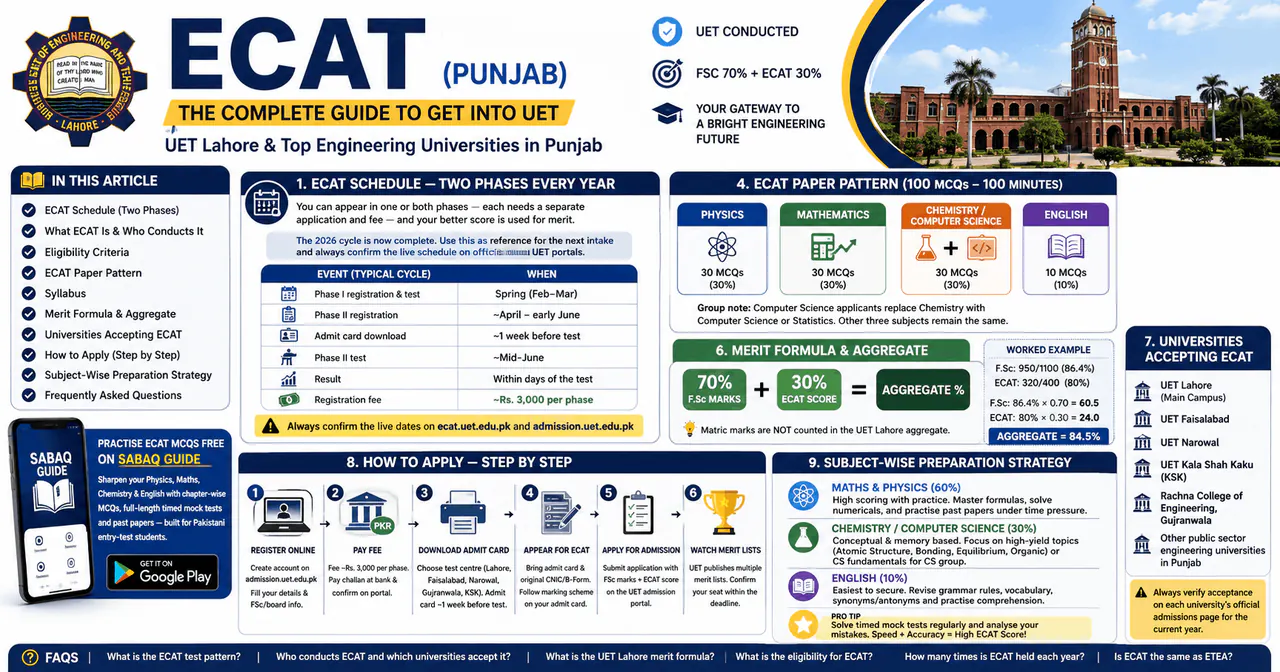
1. ECAT Schedule — Two Phases Every Year
UET Lahore holds two ECAT sessions per year (Phase I and Phase II). You can appear in one or both — each needs a separate application and fee — and your better score is used for merit.
| Event (typical cycle) | When |
|---|---|
| Phase I registration & test | Spring (Feb–Mar) |
| Phase II registration | ~April – early June |
| Admit card download | ~1 week before test |
| Phase II test | ~Mid-June |
| Result | Within days of the test |
| Registration fee | ~Rs. 3,000 per phase |
2. What ECAT Is & Who Conducts It
ECAT (Engineering College Admission Test) is conducted by the University of Engineering & Technology (UET), Lahore. It is the mandatory entry test for admission to:
- UET Lahore main campus and its constituent campuses (Faisalabad, Narowal, Kala Shah Kaku, Rachna College Gujranwala)
- Many public-sector engineering universities and colleges across Punjab that accept the UET ECAT score
ECAT tests FSc-level Physics, Mathematics, Chemistry (or Computer Science) and English — it does not introduce new material beyond your intermediate textbooks.
3. Eligibility Criteria
There is no minimum percentage required just to appear in ECAT. However, to qualify for admission you must meet the academic threshold below:
| Candidate Type | Requirement |
|---|---|
| FSc Pre-Engineering | Eligible to sit ECAT; usually 60% in FSc to qualify for engineering admission |
| FSc / ICS (for CS programs) | Relevant Maths-based intermediate; usually ~50% for Computer Science programs |
| A-Level | Relevant subjects (Maths, Physics, Chemistry) + IBCC equivalence certificate |
| DAE Holders | Relevant 3-year diploma in an engineering technology |
Anyone in a relevant science group can appear in ECAT, but your FSc percentage still gates admission (≈60% engineering, ≈50% CS) and dominates your aggregate. Keep your FSc marks strong — they're 70% of your merit.
4. ECAT Paper Pattern
ECAT is 100 MCQs in 100 minutes. For pre-engineering candidates the breakdown is:
Group note: Computer Science applicants replace the Chemistry portion with Computer Science or Statistics. The other three subjects stay the same.
ECAT has historically used +4 for a correct answer and −1 for a wrong answer (negative marking). However, UET Lahore waived negative marking for the 2026 cycle. Because this can change year to year, always confirm the exact marking scheme printed on your current admit card before deciding whether to guess.
5. ECAT Syllabus
The ECAT syllabus is the entire FSc / A-Level / DAE curriculum in the relevant subjects — straight from your Punjab Textbook Board (or Federal) books. Key areas:
| Subject | Key topics |
|---|---|
| Physics | Mechanics, Waves & Oscillations, Heat & Thermodynamics, Electrostatics, Current Electricity, Electromagnetism, Modern & Nuclear Physics |
| Mathematics | Algebra, Trigonometry, Functions & Limits, Differentiation & Integration, Analytic Geometry, Vectors, Matrices & Determinants |
| Chemistry | Atomic Structure, Chemical Bonding, States of Matter, Thermochemistry, Equilibrium, Electrochemistry, Organic Chemistry |
| Computer Science (CS group) | Fundamentals, Data types, Programming logic, Databases, Networking basics |
| English | Grammar, Sentence structure, Vocabulary, Synonyms/Antonyms, Comprehension |
6. Merit Formula & Aggregate
UET Lahore builds its merit list with a simple, FSc-heavy formula. Your FSc marks matter more than the test itself:
If you scored 950/1100 (86.4%) in FSc and 320/400 (80%) in ECAT:
- FSc: 86.4% × 0.70 = 60.5
- ECAT: 80% × 0.30 = 24.0
- Aggregate = 84.5%
Closing merit for popular programs (Electrical, Mechanical, Computer Science) at UET Lahore main campus is highly competitive — often in the mid-to-high 80s. Confirm the year's closing merit from official lists.
7. Universities Accepting ECAT
The UET Lahore ECAT score is used by UET Lahore and a range of public-sector engineering institutions in Punjab. A reference list:
| Institution | Notes |
|---|---|
| UET Lahore (Main Campus) | Primary institution; central merit list |
| UET Faisalabad / Narowal / Kala Shah Kaku (KSK) | UET Lahore constituent campuses |
| Rachna College of Engineering, Gujranwala | UET Lahore constituent college |
| Other Punjab public engineering universities | Many accept the UET ECAT score — verify each year |
8. How to Apply — Step by Step
-
Register on the UET Admission Portal
Create your account at admission.uet.edu.pk (ECAT info at ecat.uet.edu.pk). Enter your personal details, CNIC/B-Form and FSc/board information.
-
Pay the Registration Fee
The fee is approximately Rs. 3,000 per phase. Generate the challan, pay at the designated bank, and upload/confirm payment on the portal.
-
Choose Your Test Centre & Download the Admit Card
Centres are typically in Lahore, Faisalabad, Narowal, Gujranwala and Kala Shah Kaku. Your admit card (roll-number slip) appears about a week before the test — print it.
-
Appear for ECAT
Arrive early with your admit card and original CNIC/B-Form. Follow the marking scheme on your admit card. Note your score for the admission/merit step.
-
Apply for Admission & Watch the Merit Lists
Submit your admission application with FSc marks + ECAT score. UET publishes multiple merit lists — confirm your seat within the deadline if you're selected.
9. Subject-Wise Preparation Strategy
Physics, Maths and Chemistry together are 90% of the paper — that's where merit is won or lost.
Mathematics & Physics (60 MCQs — 60%)
These reward speed and accuracy. Master FSc formulas cold, practise numerical MCQs under time pressure, and drill past papers until the common question types are instinctive.
Chemistry / Computer Science (30 MCQs — 30%)
Conceptual and memory-based. Focus on atomic structure, bonding, equilibrium and organic reactions (or CS fundamentals for the CS group). High-yield, fast-to-revise marks.
English (10 MCQs — 10%)
The easiest section to lock in. Revise grammar rules, high-frequency vocabulary, and practise short comprehension passages.
Frequently Asked Questions
What is the ECAT test pattern?
ECAT is 100 MCQs in 100 minutes. Pre-engineering: Physics 30, Mathematics 30, Chemistry 30, English 10. CS applicants replace Chemistry with Computer Science/Statistics. It historically used +4 correct / −1 wrong, but UET waived negative marking for 2026 — always confirm on your admit card.
Who conducts ECAT and which universities accept it?
ECAT is conducted by UET Lahore for admission to UET Lahore, its constituent campuses (Faisalabad, Narowal, KSK, Rachna College Gujranwala) and many public-sector engineering universities in Punjab. Verify acceptance on each university's admission page each year.
What is the UET Lahore merit formula?
FSc 70% + ECAT 30%. Matric marks are not counted at UET Lahore. Confirm the exact weightage in the official prospectus for your year.
What is the eligibility for ECAT?
No minimum percentage to appear. To qualify for admission you typically need ~60% in FSc (engineering) or ~50% (Computer Science). A-Level students need an IBCC equivalence certificate.
How many times is ECAT held each year?
Twice — Phase I and Phase II. You may attempt one or both; your better score counts for merit. Each phase needs a separate application and fee (~Rs. 3,000).
Is ECAT the same as ETEA?
No. ECAT = UET Lahore's engineering test for Punjab. ETEA = the KPK engineering test (including UET Peshawar). Different bodies, schedules and accepting universities. See our ETEA guide for KPK.
Final word: ECAT rewards a simple plan — keep your FSc marks high (that's 70% of merit), master Maths & Physics, and drill past papers under time pressure. Confirm every date and the marking scheme on the official UET Lahore portals, and you're set. Best of luck! 🌟