
The University of Engineering & Technology (UET), Peshawar is KPK's flagship public engineering institution — and getting in requires one thing above all else: clearing the ETEA Computer-Based Entrance Test (CBT). Conducted by the Educational Testing and Evaluation Agency (ETEA), this test is the mandatory gateway to UET Peshawar and every other public and private engineering institution in Khyber Pakhtunkhwa.
What's new in 2026? Following Pakistan Engineering Council (PEC) policy, students now get two separate chances to attempt the entrance test — Phase-I and Phase-II — so you can improve your score and maximize your merit. This guide covers everything: eligibility, the two-phase schedule, the complete CBT paper pattern, step-by-step registration, all four UET campuses, every university that accepts ETEA scores, how merit is calculated, and a focused preparation strategy.
The KPK entry-test body — syllabus, pattern & prep.
BSc Engineering via the ETEA test — eligibility, merit & how to apply.
BS Computing — merit on FSc marks, NO entry test.
- Eligibility Criteria
- Entrance Test Schedule 2026 (Two Phases)
- ETEA CBT Paper Pattern
- UET Peshawar Campuses & Programs
- How to Apply (Step by Step)
- All Universities Accepting ETEA Scores
- Merit Formula & Calculation
- Subject-Wise Preparation Strategy
- Making the Most of Two Attempts
- Frequently Asked Questions
1. Eligibility Criteria
UET Peshawar follows ETEA's eligibility requirements. You must meet the academic criteria below to sit for the 2026 entrance test:
| Candidate Type | Minimum Requirement |
|---|---|
| F.Sc Pre-Engineering / CS / Pre-Medical with Additional Math | 60% unadjusted marks in Intermediate from a recognized BISE board |
| F.Sc Pre-Medical (specific categories) | 60% unadjusted marks in Intermediate from a recognized BISE board |
| DAE / B-Tech Holders | 60% unadjusted marks in a 3-year post-Matric Diploma or B-Tech |
| A-Level Students | IBCC equivalence certificate meeting the 60% equivalent threshold |
| Result Awaiting (Part-II) | Provisionally eligible — may sit for the test pending final results |
The 60% threshold is based on unadjusted marks — meaning grace marks and improvement marks added by the board are not counted. If your adjusted percentage is 60% but your unadjusted marks are below the cutoff, you are not eligible. Always check your official board result sheet, not the adjusted percentage on your card.
Yes — Pre-Medical students are eligible for ETEA Engineering. However, ETEA's paper heavily tests Mathematics (35 MCQs) and Physics (40 MCQs). Students without Additional Mathematics in FSc will find preparation significantly harder and typically face higher closing merit at most institutes.
If you are still in FSc Pre-Medical and considering engineering, taking Additional Mathematics as an elective is strongly recommended. It not only prepares you for the paper but also brings your merit calculation closer to the Pre-Engineering group.
2. Entrance Test Schedule 2026 — Two Phases
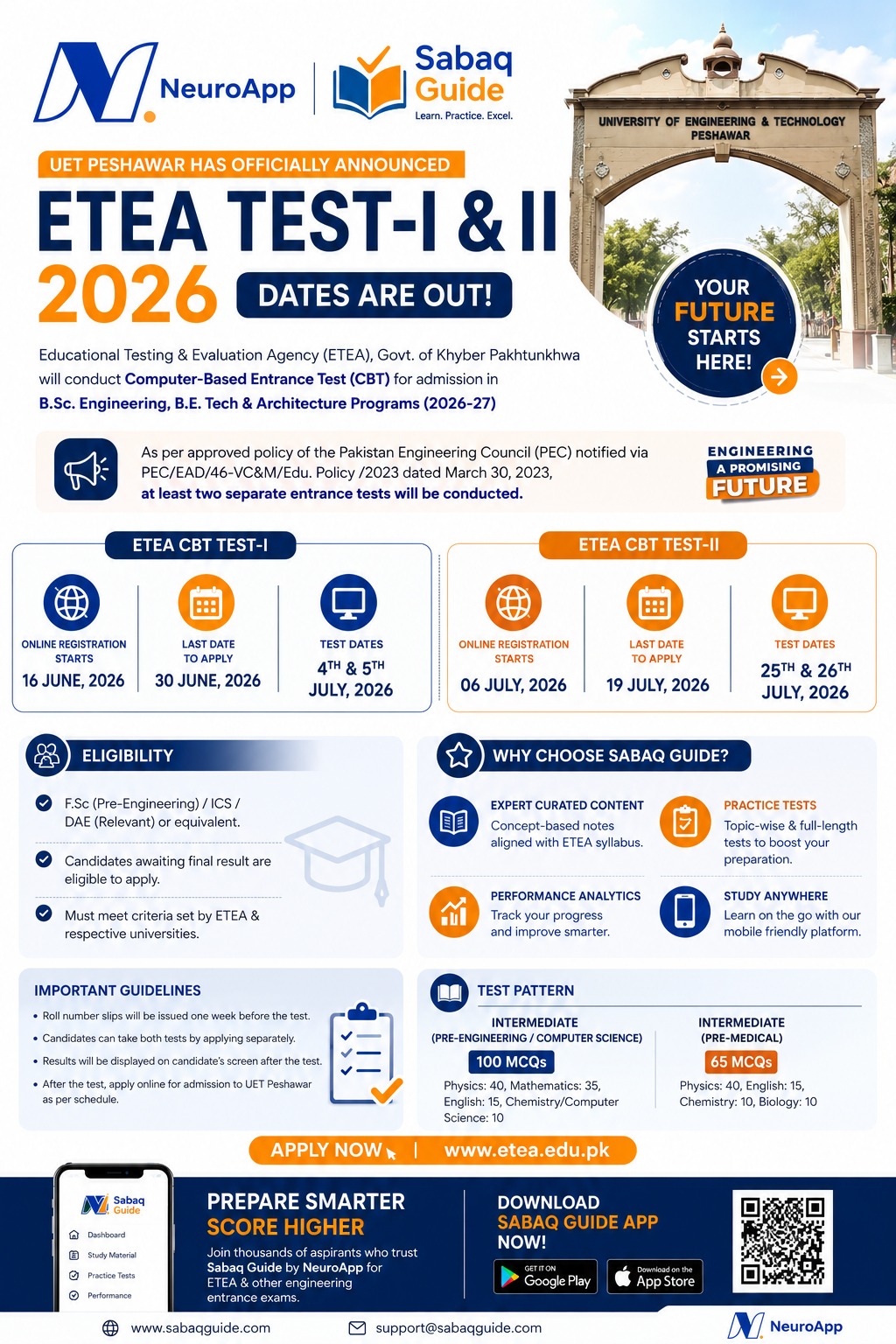
UET Peshawar has officially announced the ETEA Computer-Based Entrance Test 2026 schedule for admission to B.Sc Engineering, B.E Technology (B.Tech) and B.Architecture programs (Session 2026–27). Two test opportunities (Test-I & Test-II) are confirmed, with no negative marking. Test-I registration opened 16 June 2026. Apply at etea.edu.pk.
Under Pakistan Engineering Council (PEC) policy (notified via PEC/EAD/46-VC&M/Edu. Policy/2023 dated March 30, 2023), the ETEA engineering test uses a two-phase format — and the 2026 dates are now confirmed. You can appear in one or both phases — each requires a separate application and fee. The better score of your two attempts is used for merit.
Test-I (Phase I)
- Registration Opens16 June 2026
- Last Date to Apply30 June 2026
- Admit Card Download~1 week before test
- Test Dates4 & 5 July 2026
Test-II (Phase II)
- Registration Opens6 July 2026
- Last Date to Apply19 July 2026
- Admit Card Download~1 week before test
- Test Dates25 & 26 July 2026
Share on WhatsApp
3. ETEA CBT Paper Pattern
The ETEA Engineering test is fully Computer-Based (CBT) — you sit at a terminal, answer MCQs on screen, and your result appears immediately when you submit. There is NO negative marking, so you should attempt every single question.
A. For Pre-Engineering / CS / DAE / Pre-Medical with Additional Math
Total: 100 MCQs
B. For Pre-Medical (Specific Categories)
Total: 65 MCQs
You are assigned a computer terminal at the test centre. Questions appear one at a time. You can flag questions to revisit before submitting. The system locks automatically at the time limit. Your score appears on screen the moment you hit Submit — no waiting for results.
4. UET Peshawar Campuses & Programs
UET Peshawar has four campuses across KPK, each offering engineering disciplines aligned with the region's development needs. Admission is processed centrally — your ETEA score and aggregate determine which campus and program you qualify for.
Main Campus — Peshawar
Civil, Electrical, Mechanical, Industrial & Manufacturing, Chemical, Computer Systems, Software, Telecommunications, Urban & Regional Planning, B.Architecture
Abbottabad Campus
Civil, Electrical, Mechanical, Computer Systems Engineering — serves Hazara Division
Bannu Campus
Civil, Electrical, Mechanical Engineering — serves southern KPK districts
Jalozai Campus
Civil, Electrical, Mechanical, Chemical Engineering — newer campus in Nowshera District
5. How to Apply — Step by Step
The admission process has two distinct stages: Stage 1 is the ETEA entrance test, and Stage 2 is the UET Peshawar university admission application. Both are separate — passing Stage 1 does not automatically enroll you.
Stage 1: ETEA Entrance Test
-
Register Online at ETEA Portal
Visit etea.edu.pk and register before the official deadline (Test-I closes 30 June 2026; Test-II closes 19 July 2026). Fill in your personal details, CNIC/B-Form, board registration number, and subject group.
-
Pay the Registration Fee
The non-refundable fee is approximately Rs. 1,000 per test phase (confirm on the portal each year). A bank challan is generated — deposit at any designated branch and upload the payment slip online.
-
Download Your Admit Card (Roll Number Slip)
Approximately one week before the test, your admit card becomes available on the ETEA portal. It contains your assigned date, time, and test centre. Print it — you cannot enter the centre without it.
-
Appear for the CBT
Arrive at least 30 minutes early with your admit card and original CNIC/B-Form. Mobiles and calculators are strictly prohibited. Your result appears on screen immediately after submission.
Stage 2: UET Peshawar University Admission
-
Apply at UET Peshawar Admissions Portal
After ETEA results, apply separately at enggentrancetest.pk. Enter your ETEA score, FSc marks, and Matric marks. This is where your aggregate is calculated.
-
Submit Documents
Prepare: FSc marksheet/result card, Matric certificate, CNIC/B-Form (original + 2 copies), ETEA score card, 4 passport photos, and IBCC equivalence certificate if applicable.
-
Check Merit Lists
UET publishes merit lists on the official portal. Monitor carefully — typically 2–3 merit lists are issued to fill remaining seats. If you appear on a list, you must confirm your seat within the deadline or it is forfeited.
6. Universities Accepting ETEA (UET Peshawar) Scores
The ETEA Engineering test conducted by UET Peshawar is required for admission to all public and private sector engineering universities and colleges in Khyber Pakhtunkhwa. Below is a reference list of key institutions:
| Institution | Type | Notes |
|---|---|---|
| UET Peshawar (Main, Abbottabad, Bannu, Jalozai) | Public | Primary institution; admits via central merit list |
| CECOS University of IT & Emerging Sciences | Private | Peshawar; ETEA mandatory |
| Sarhad University of Science & IT | Private | Peshawar |
| Abasyn University | Private | Peshawar |
| City University of Science & IT | Private | Peshawar |
| Iqra National University | Private | Peshawar |
| Bannu University of Science & Technology | Public | Bannu, KPK |
| University of Engineering & Technology, Mardan | Public | UET Mardan campus |
| Namal University, Mianwali | Private | Explicitly accepts ETEA Test-I (outside KPK) |
7. Merit Formula & Aggregate Calculation
ETEA only conducts the test and publishes scores — it does not prepare merit lists. Each affiliated institution prepares its own merit list using its own formula. The most commonly used formula at UET Peshawar and affiliated institutions is:
How to Calculate Your Aggregate
Here is how the formula works with an example:
| Component | Your Marks | Weight | Contribution |
|---|---|---|---|
| ETEA Score (out of 100) | 72 | 50% | 36.0 |
| F.Sc (out of 1100) | 880 → 80% | 40% | 32.0 |
| Matric (out of 1050) | 840 → 80% | 10% | 8.0 |
| Total Aggregate | 76.0% | ||
Closing merit varies by program and year. As a general reference from recent years:
- Electrical Engineering (Main Campus): ~78–82% closing aggregate
- Civil Engineering (Main Campus): ~76–80%
- Computer Systems Engineering: ~79–83%
- Mechanical Engineering: ~75–79%
- Abbottabad / Bannu Campuses: Typically 3–6% lower than Main Campus
These are indicative ranges based on historical data — actual 2026 merit will depend on the number of applicants and seats. Always check the official merit lists.
8. Subject-Wise Preparation Strategy
ETEA Engineering is a 100-MCQ CBT, and the best strategy is simple: Physics and Maths together make up 75% of your paper. Win those two and the test is yours.
Physics (40 MCQs — 40%)
Physics is the single highest-weighted subject. Cover all chapters from FSc Part 1 and Part 2 — KPK Textbook Board or Federal Board. ETEA Physics favours conceptual questions, numerical MCQs, and formula-based calculations. Do not skip Optics, Modern Physics, Electromagnetism, or Oscillations.
- Solve all textbook exercises and numerical examples
- Use past ETEA papers (2020–2025) to spot recurring topic areas
- Practice conversion of units and formula recall under time pressure
Mathematics (35 MCQs — 35%)
Mathematics is the differentiator in merit. Students who score 30+ here jump several percentage points in aggregate. Focus on Algebra, Calculus, Trigonometry, and Coordinate Geometry from both Part 1 and 2.
- Practice speed — most Maths MCQs require calculation, not just concepts
- Master common formulas cold (derivatives, integrals, trig identities)
- Target past paper errors first: where are students losing marks?
English (15 MCQs — 15%)
ETEA English tests grammar rules, vocabulary, and comprehension. It is the easiest to score consistently with minimal effort — 12–14 out of 15 is achievable for any FSc student who spends 2 weeks on it.
- Revise Parts of Speech, Tenses, Active/Passive Voice, and Direct/Indirect Speech
- Learn 200 high-frequency ETEA vocabulary words
- Practice 5 comprehension passages per week
Chemistry / Computer Science (10 MCQs — 10%)
Only 10 MCQs — do not over-invest here. A focused 2-week revision of key organic and inorganic chemistry reactions, atomic structure, and bonding is enough. CS students cover data structures, algorithms, and programming fundamentals.
9. Making the Most of Two Attempts
The two-attempt PEC policy is a major opportunity. Here is how to use it strategically:
- Treat Phase-I as a dress rehearsal — the CBT environment, timing pressure, and question style are unfamiliar the first time. Even a good Phase-I score can improve with experience.
- Register for both phases immediately when registration opens. Missing Phase-II registration because you "felt fine after Phase-I" and then receiving a disappointing result is a costly mistake.
- After Phase-I, analyse your weak areas — you know your score instantly, so you have weeks to close the gap before Phase-II.
- Only your best score counts for merit — a lower Phase-II score cannot hurt you. There is no downside to attempting both.
Frequently Asked Questions
When is the ETEA Engineering Test 2026 for UET Peshawar?
UET Peshawar has officially announced two test opportunities for 2026. Test-I: online registration ran 16–30 June 2026, with the test held on 4 & 5 July 2026. Test-II: online registration runs 6–19 July 2026, with the test on 25 & 26 July 2026. Both are Computer-Based (CBT) with no negative marking. You can appear in one or both — your better score counts for merit. Always confirm dates on etea.edu.pk before applying.
What is the minimum marks to pass the ETEA Engineering test?
There is no fixed "pass" threshold for the ETEA Engineering test itself — ETEA simply publishes your raw score. What matters is your aggregate percentage once your FSc and Matric marks are factored in, and how that compares to the closing merit of your target program at UET Peshawar. Historically, an ETEA score of 60–65+ is competitive for mid-tier engineering programs at UET campuses.
Can I apply for both Phase-I and Phase-II?
Yes. Per PEC policy, you can register and appear for both Phase-I and Phase-II as separate applications. Each requires a separate registration fee (~Rs. 1,000). Your better score from the two attempts is used for merit list preparation. There is no penalty for a lower score in the second attempt.
Is the ETEA Engineering test the same as the MDCAT test?
No. ETEA conducts separate tests for Engineering and Medical programs. The ETEA Engineering test (for UET Peshawar) has 100 MCQs in Physics, Maths, English, and Chemistry/CS with no negative marking. MDCAT is a separate national test administered by PMDC for MBBS and BDS admissions. The two tests have completely different syllabi, patterns, and administering bodies.
What documents do I need for the UET Peshawar admission process?
For the ETEA test: CNIC/B-Form and printed admit card. For UET Peshawar admission after results: FSc marksheet (original + 2 copies), Matric certificate (original + 2 copies), CNIC/B-Form (original + 2 copies), ETEA score card, 4 recent passport-size photos, and for A-Level students, IBCC equivalence certificate. DAE students need their diploma certificate and transcripts.
Does Namal University, Mianwali accept ETEA scores?
Yes. Namal University, Mianwali explicitly accepts ETEA (UET Peshawar) Test-I scores for its engineering programs. This is notable because Namal is outside KPK but recognises the ETEA test — making it a viable option for strong ETEA scorers who want a private university with a good reputation. Confirm this on Namal's official admissions portal each year as policies can change.
What is B.Architecture at UET Peshawar and how is admission different?
B.Architecture is a 5-year professional degree offered only at UET Peshawar Main Campus. Admission requires both an ETEA score and a separate aptitude/drawing test specific to Architecture. Students with strong artistic and spatial reasoning skills alongside solid Physics and Maths results are competitive. Check the UET Peshawar Architecture department's specific admissions criteria in the annual prospectus.